Data Product Interaction Mapping
A useful conversation to have at the start of the ideation is how does different data contribute to the overall success of an idea.
Key Ideas
-
The focus of the ideation is to navigate towards just enough clarity to start the delivery. It is not to have complete set of requirements. Rather, the delivery of first version of the system will inform the next steps of the evolution.
-
A Data Product Interaction Map helps to identify all the data products that contribute to an idea.
-
It is a collaborative exercise, involving business process owners, technologists, and subject matter experts.
-
It helps to identify dependencies, data sources, and potential challenges early in the ideation phase.
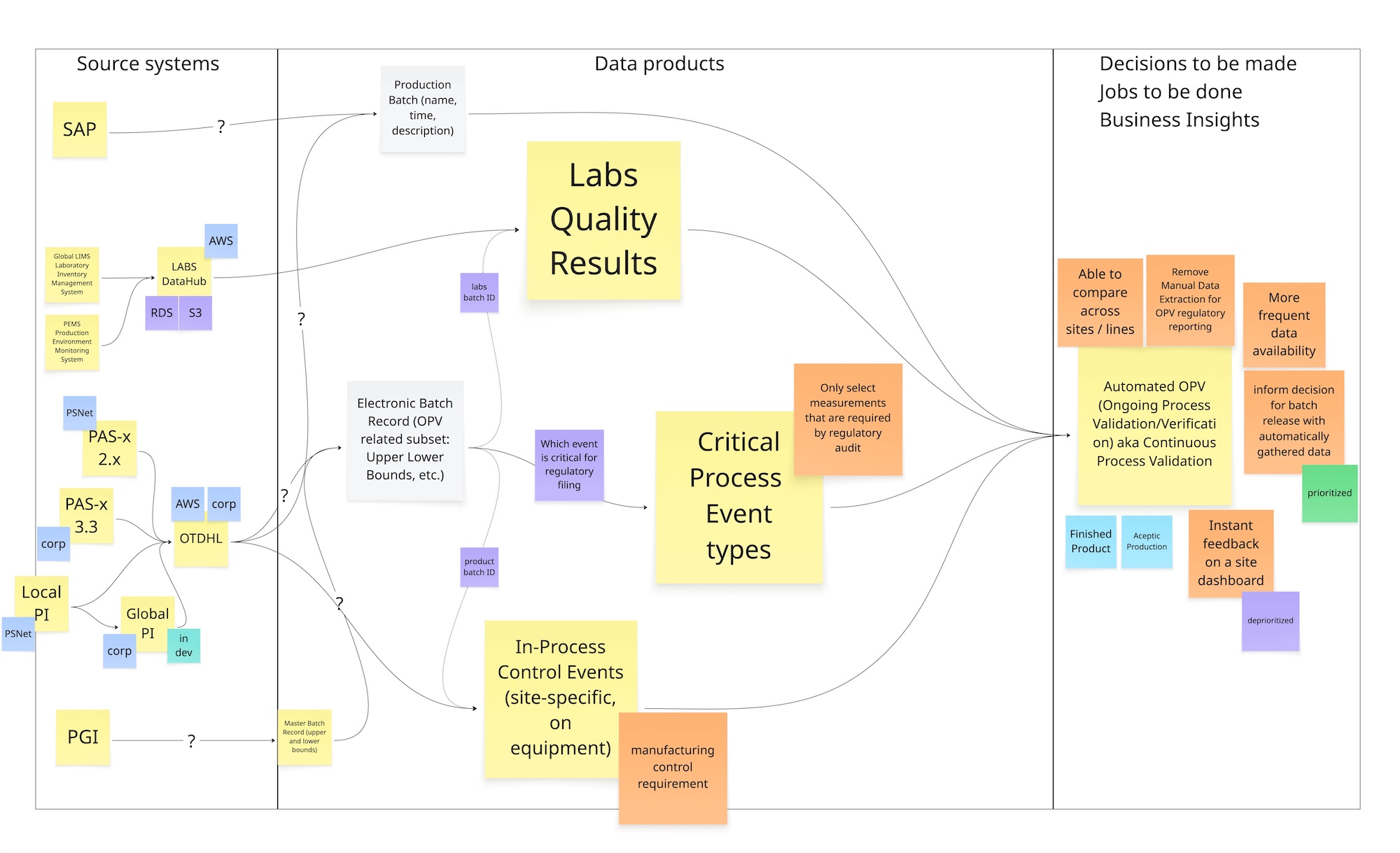
This is the first conversation in the ideation phase. It is useful to understand the use cases, and the outcomes that the business is looking to achieve. It is starting from the "decisions to be made" and "insights to be gained" perspective and then working backwards identifies what data is needed to achieve this.
How to facilitate#
This is a collaborative exercise. Facilitating online can be done using Miro. In-person, a whiteboard and sticky notes can be used. It is useful to keep the results in a format that is easy to revisit and update as the understanding of the context evolves.
Facilitation Steps#
-
The group consisting of the business process owner, the technologists, and the SMEs collaboratively gather the use cases and the outcomes that the business is looking to achieve. When use cases are presented, get clarity on what benefit the use case completeness brings to the business.
-
The facilitator starts on the right side with the decisions to be made connected to the use cases. The group clarifies what components need to be in place to inform such decisions - whether it is a report, a dashboard, a real-time alert, or a part of an application.
-
The group then works backwards to identify what data contributes to the outcomes. It is useful to follow the conversation with Domain Driven Design (DDD) principles, identifying the bounded contexts and the aggregates will help naming the data products.
-
From the data products, the group identifies the data sources that are needed for the data products to be built. It can be existing data products, raw data sources, or external data.
References#
- Designing Data Products
- Building Evolutionary Architectures
- Data Mesh Principles
- Domain Driven Design
- Ports and Adapters Architecture (Hexagonal architecture)
- Best Simple System For Now