Data Product Canvas
After identifying analytical data that contribute to an idea, a data product canvas helps to understand what the objectives of the individual data products are.
Key Ideas
-
The focus of the ideation is to navigate towards just enough clarity to start the delivery. It is not to have complete set of requirements. Rather, the delivery of first version of the system will inform the next steps of the evolution.
-
A Data Product must clearly define its business value from the concept phase for a single product.
-
Product Owner should refine high level requirements from the use case statement.
-
Engage potential Data Product consumers early to align the product with their needs and clarify its value and use cases.
This conversation should be facilitated after the data product interaction map has been discussed and the context is understood. At this point, Solution Delivery Manager and Product Owner is identified. Product Owner is responsible for documenting the results from this phase and Solution Delivery Manager will assist the Product Owner.
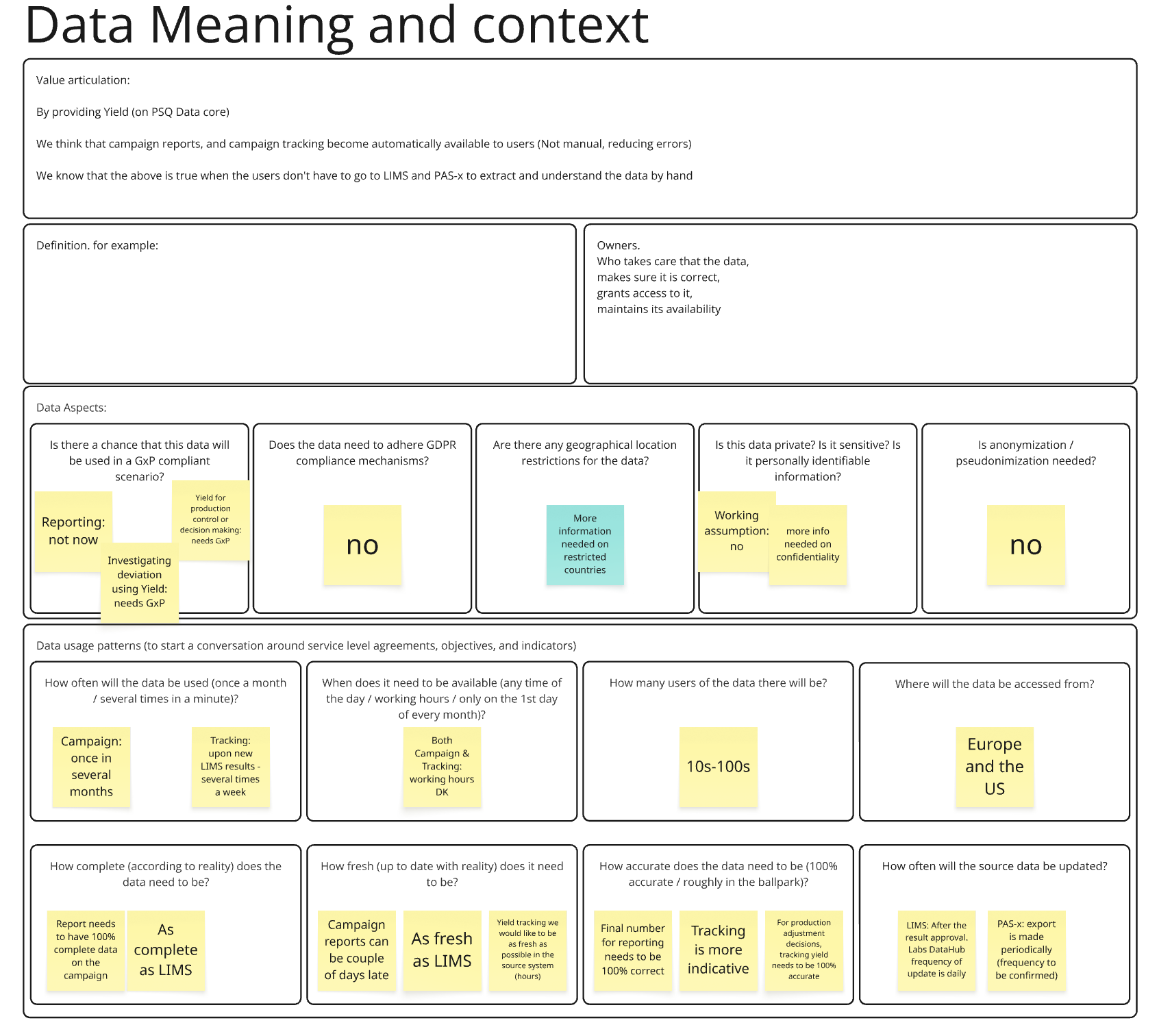
How to facilitate#
This is a collaborative exercise. Facilitating online can be done using Miro. In-person, a whiteboard and sticky notes can be used. It is useful to keep the results in a format that is easy to revisit and update as the understanding of the context evolves.
Prepare the session#
If facilitating online, you can use a Miro template Data Product Canvas Template.
If facilitating in-person, prepare a whiteboard with the questions from the canvas.
Facilitation steps#
- The group consisting of the business process owner, the technologists, and the SMEs collaboratively agree on the value hypothesis,
Example
We believe that by [delivering/making/providing X]
we will [achieve/help/create outcome Y,Z]
we know that its true when: [criteria A,B,C is met]
-
The group explores the data aspects of the product. This includes:
- GDPR and personal data restrictions
- Geographical restrictions of the data
- Data sensitivity and classification
- GxP or other regulatory requirements
-
The conversation moves on to the likely usage patterns of the data:
- How often will the data be accessed?
- How many users will access the data?
- When does the data need to be available?
- Where will the data be accessed from?
- How complete the data needs to be?
- How fresh the data needs to be?
- How accurate the data needs to be?
- How long the data needs to be retained?
- How often will the source data be updated?
-
The Product Owner needs to refine the above use case into proper high level business requirements which can contain below:
- Use case context, description, and value proposition.
- Roles involved in consumption, provision, and support
- KPIs definitions (e.g., if the product is an Analytical Dashboard)
- Scope definition
- Business Stakeholders: SMEs, access/data providers, etc.
- Product owners/delegates and consumers (for requirements approval and acceptance)
After the session#
-
Get business approval if needed for the above requirements
-
If Business Approval is received, download Business Requirements Document, fill in the information known at this point and upload to EPIC ADO Board.
Go to Playbook Main Page Previous: Data Product Interaction Map Next: Feasibility Assessment